Mountains of paperwork are still common in many offices in Japan and elsewhere. It can be physical or digital. A recent survey of over 10,000 office workers by a U.S. tech firm found respondents were wasting more than 40% of their day on repetitive data work. Internet of Things (IoT) sensors are playing an increasing role in generating data, but manual data entry hasn’t gone away. In aging Japan, a shrinking workforce is putting pressure on companies to change. To address this challenge, the Japanese public and private sectors are harnessing the power of artificial intelligence to automate tasks and boost worker productivity and job satisfaction.
Cinnamon AI spices up dull tasks
One company that has been turning heads in this effort is Tokyo-based Cinnamon AI. Founded in 2012, it’s committed to extending human potential to transform unstructured date into actionable, structured data. Its main product is Flax Scanner, a “cognitive document reader” that uses machine learning algorithms to automatically identify and retrieve key text elements in documents. It works with digital and printed sources, including faxes, invoices, contracts, handwritten notes, PDFs, and Word files. The company says it has an accuracy of over 99%.
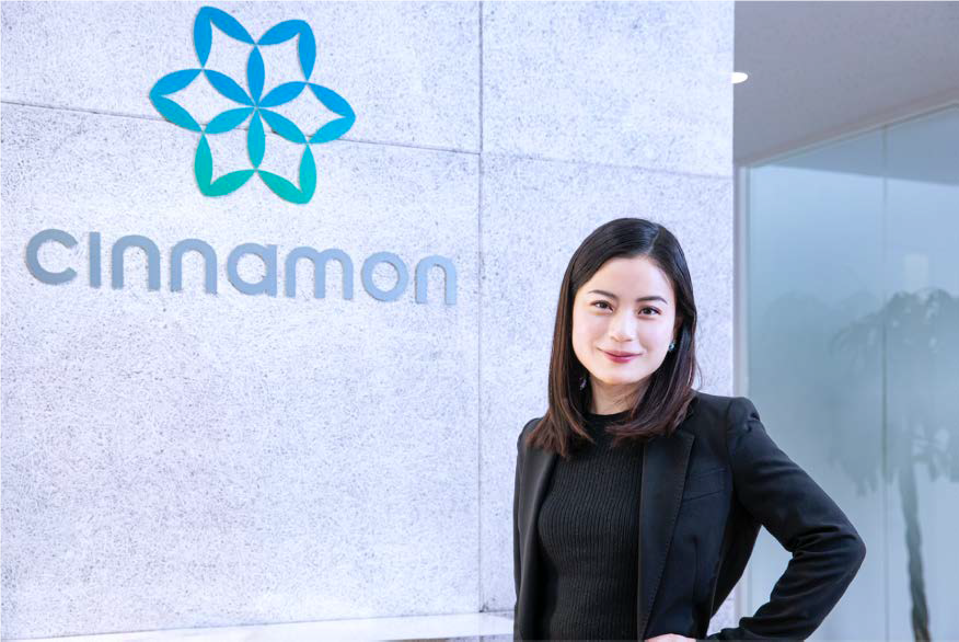
Hirano Miku is CEO and cofounder of Cinnamon AI, a Tokyo-based office work automation startup that has raised over $17 million.
JAPAN BRANDVOICE“We live in the information era, and companies have tons of data—actually 80% of all data is unstructured data or untagged data, which cannot be recognized by AI. Our work is filled with unstructured data, such as emails, videos, images, and speeches,” says Hirano Miku, cofounder and CEO of Cinnamon AI. “Until now, we’ve needed humans to work on data to structure it for databases. Unstructured data is the key for office workers to work more efficiently. We create AI to understand unstructured data.”

Cutting down on paperwork and repetitive tasks will make workers more productive and happy, says Hirano.
JAPAN BRANDVOICEBusinesses can save up to 90% on labor costs with Cinnamon AI’s solutions, according to Hirano. Her company’s solutions have been adopted by major brands in Japan such as Dai-ichi Life Insurance, Kansai Electric Power, and Showa Denko. Hirano now has her sights set on overseas markets such as the U.S., where the company has a sales office in Texas.
Forging a global company
Hirano became interested in and focused on computer science and AI as a student at the University of Tokyo. It was during that time that she met Kitano Hiroaki, CEO of Sony Computer Science Laboratories, who inspired her to enter the startup world; Kitano is now a Cinnamon AI advisor. She sold her first company, smartphone middleware maker Naked Technologies, to Japanese social network Mixi in 2011. She then founded Cinnamon AI with fellow AI specialist Hotta Hajime and began focusing on AI as a business in 2016. Driven by Hirano’s passion for innovation, the firm now has over $17 million in funding, AI labs in Taiwan and Vietnam due to its many skilled programmers. The company’s main businesses are its AI products and AI consulting services.
Hirano says Cinnamon AI’s strengths lie in its ability to turn unstructured data into structured data that can help companies improve productivity. She also thinks her ambitions for Cinnamon AI’s growth are another thing that make it unique. She wants to be global—as proof, only 40 of Cinnamon AI’s 200 staff are Japanese.
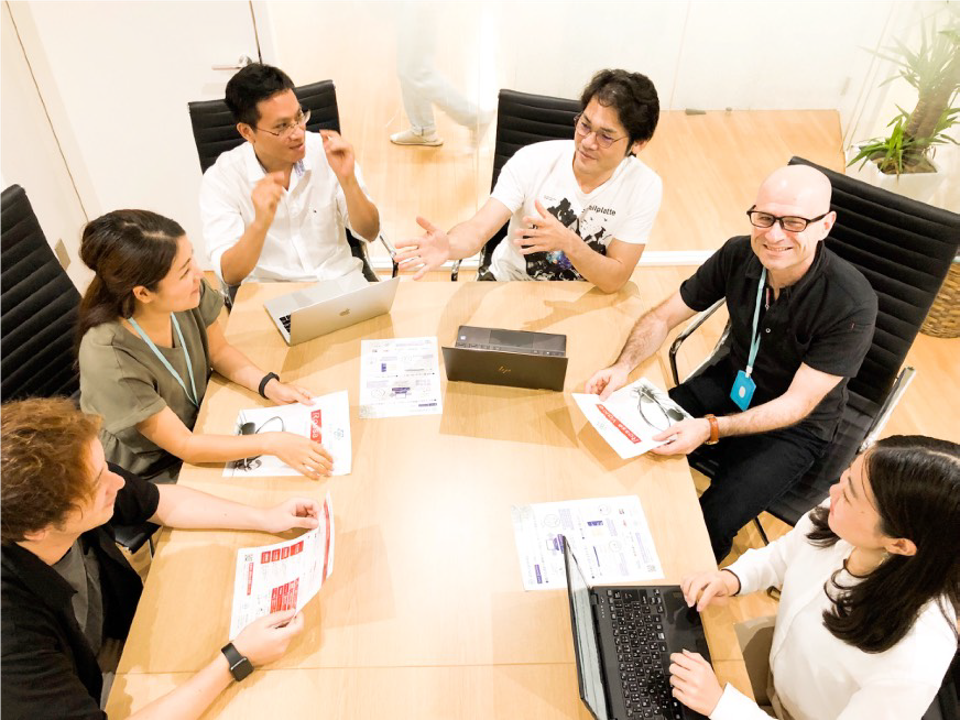
Meetings at Cinnamon AI’s Tokyo headquarters include talented international workers.
JAPAN BRANDVOICE“I wanted to make a company like Google to change everybody’s life,” Hirano says about her first company. “In 2017, my son was born, and that influenced our mission at Cinnamon AI. I wanted to change the current lifestyle in Japan with everyone working long hours and feeling so much pressure. I’d like to make a world in which people can be happy and only work five hours a day.”
AI-powered future
Japan’s Ministry of Economy, Trade and Industry chose Cinnamon AI for its J-Startup program highlighting pioneering young Japanese companies, and it’s a good example of how the public and private sector are cooperating to innovate business and human resource development. This is one effort to seed the coming age of cyber-physical integration known as Society 5.0. This human-centered, technological society is expected to free us from stressful work and help us enjoy more fullfiling lives. Gathering data to free employees from administrative work, Cinnamon AI is one of the leading companies helping Japan realize Society 5.0.
Japan has long been a dominant player in fields such as industrial automation, and it’s now focused on cultivating “hidden gems” in AI such as tech unicorn Preferred Networks, valued at over $2 billion, so their technologies can benefit society. Under its 2018 Future Investment Strategy, the Government is emphasizing what it calls human-centric AI. It’s founded on the three principles of dignity, diversity and inclusion, and sustainability. In practice, it means that AI systems should be used to augment human workers, who are the decision-makers when it comes to using the fruits of AI, and that there should be equal education opportunities for AI literacy. The strategy also highlights the importance of privacy protection, ensuring security, fair competition, transparency and innovation.

“I’d like to make a world in which people can be happy and only work five hours a day,” says Hirano.
JAPAN BRANDVOICE“We’re very aligned with government policy because of our mission of changing work styles,” says Hirano. “The purpose of the J Startup program is to create unicorns, and we want to achieve that quickly while aiming to be the number one global business AI company.”
Society 5.0
What is Society 5.0?
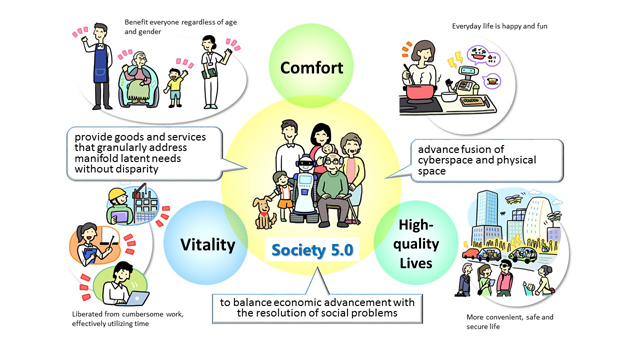
One definition: "A human-centered society that balances economic advancement with the resolution of social problems by a system that highly integrates cyberspace and physical space."
Society 5.0 was proposed in the 5th Science and Technology Basic Plan as a future society that Japan should aspire to. It follows the hunting society (Society 1.0), agricultural society (Society 2.0), industrial society (Society 3.0), and information society (Society 4.0).
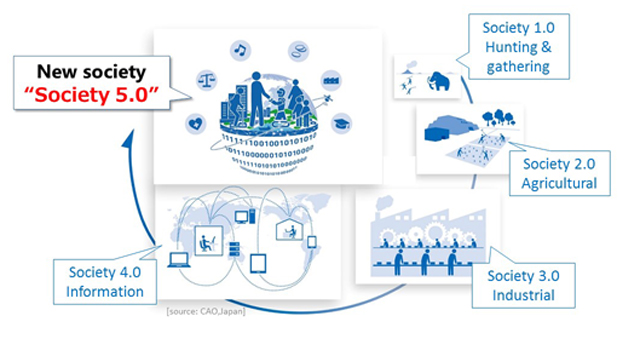
Achieving Society 5.0
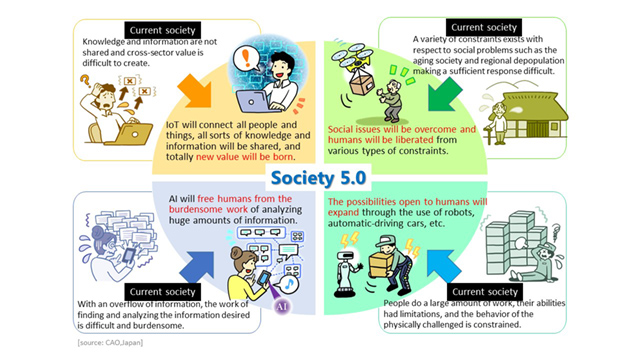
In the information society (Society 4.0), cross-sectional sharing of knowledge and information was not enough, and cooperation was difficult.
Because there is a limit to what people can do, the task of finding the necessary information from overflowing information and analyzing it was a burden, and the labor and scope of action were restricted due to age and varying degrees of ability. Also, due to various restrictions on issues such as a decreasing birthrate and aging population and local depopulation, it was difficult to respond adequately.
Social reform (innovation) in Society 5.0 will achieve a forward-looking society that breaks down the existing sense of stagnation, a society whose members have mutual respect for each other, transcending the generations, and a society in which each and every person can lead an active and enjoyable life.
How Society 5.0 works
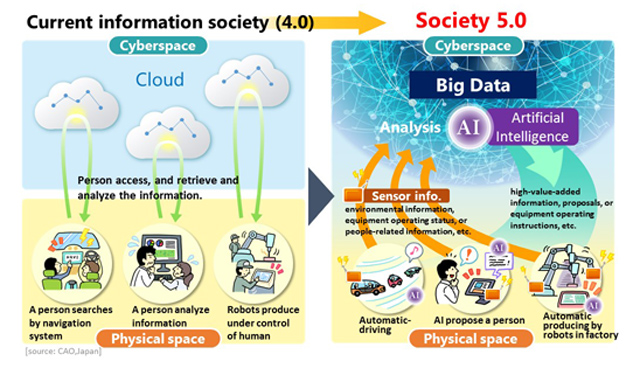
Society 5.0 achieves a high degree of convergence between cyberspace (virtual space) and physical space (real space). In the past information society (Society 4.0), people would access a cloud service (databases) in cyberspace via the Internet and search for, retrieve, and analyze information or data.
In Society 5.0, a huge amount of information from sensors in physical space is accumulated in cyberspace. In cyberspace, this big data is analyzed by artificial intelligence (AI), and the analysis results are fed back to humans in physical space in various forms.
In the past information society, the common practice was to collect information via the network and have it analyzed by humans. In Society 5.0, however, people, things, and systems are all connected in cyberspace and optimal results obtained by AI exceeding the capabilities of humans are fed back to physical space. This process brings new value to industry and society in ways not previously possible.
Society 5.0 Balances Economic Development and Solves Social Issues
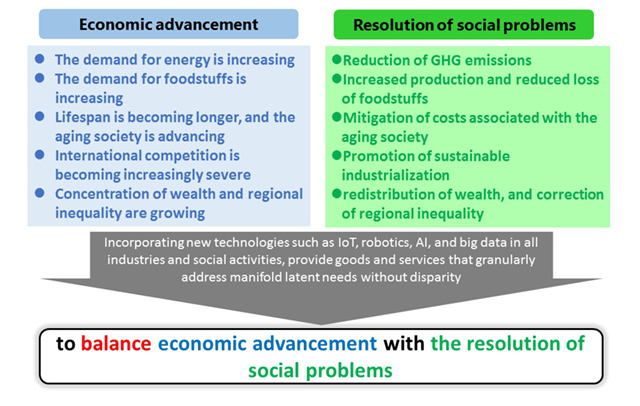
It can be said that the environment surrounding Japan and the world is in an era of drastic change. As the economy grows, life is becoming prosperous and convenient, the demand for energy and foodstuffs is increasing, lifespan is becoming longer, and the aging society is advancing. In addition, the globalization of the economy is progressing, international competition is becoming increasingly severe, and problems such as the concentration of wealth and regional inequality are growing. Social problems that must be solved in opposition (as a tradeoff) to such economic development have become increasingly complex. Here, a variety of measures have become necessary such as the reduction of greenhouse gas (GHG) emissions, increased production and reduced loss of foodstuffs, mitigation of costs associated with the aging society, support of sustainable industrialization, redistribution of wealth, and correction of regional inequality, but achieving both economic development and solutions to social problems at the same time has proven to be difficult in the present social system.
In the face of such major changes in the world, new technologies such as IoT, robotics, AI, and big data, all of which can affect the course of a society, are continuing to progress. Japan seeks to make Society 5.0 a reality as a new society that incorporates these new technologies in all industries and social activities and achieves both economic development and solutions to social problems in parallel.
Economic Development and Solutions to Social Problems in Society 5.0
In Society 5.0, new value created through innovation will eliminate regional, age, gender, and language gaps and enable the provision of products and services finely tailored to diverse individual needs and latent needs. In this way, it will be possible to achieve a society that can both promote economic development and find solutions to social problems.
Achieving such a society, however, will not be without its difficulties, and Japan intends to face them head-on with the aim of being the first in the world as a country facing challenging issues to present a model future society.
Examples of New Value in Each Field
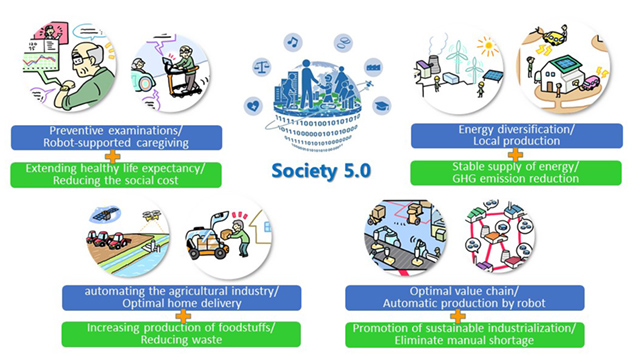
Examples of new values in each field are introduced at the link destination.
Mobility / Healthcare and caregiving / Manufacturing / Agriculture / Food / Disaster Prevention / Energy
Society 5.0 Will Bring About a Human-centered Society
In society up to now, a priority has generally been placed on social, economic, and organizational systems with the result that gaps have arisen in products and services that individuals receive based on individual abilities and other reasons. In contrast, Society 5.0 achieves advanced convergence between cyberspace and physical space, enabling AI-based on big data and robots to perform or support as an agent the work and adjustments that humans have done up to now. This frees humans from everyday cumbersome work and tasks that they are not particularly good at, and through the creation of new value, it enables the provision of only those products and services that are needed to the people that need them at the time they are needed, thereby optimizing the entire social and organizational system.
This is a society centered on each and every person and not a future controled and monitored by AI and robots.
Achieving Society 5.0 with these attributes would enable not just Japan but the world as well to realize economic development while solving key social problems. It would also contribute to meeting the Sustainable Development Goals (SDGs) established by the United Nations.
Japan aims to become the first country in the world to achieve a human-centered society (Society 5.0) in which anyone can enjoy a high quality of life full of vigor. It intends to accomplish this by incorporating advanced technologies in diverse industries and social activities and fostering innovation to create new value.